Sauva Negra and Castell de Castellcir from Centelles
Our first Midweek Hikers jaunt - to see the little-known 'fageda / hayedo' close to Barcelona, Catalonia's smallest protected space, the Sauva Negra. Much as the beechwood forest is probably the most common type in all of Europe, this far south its presence is anomalous and as such the Catalans have some kind of obsession with the beauty of the fageda which seems to be contagious. This seems to be mostly for the autumn colours, which are almost totally absent from the more typical evergreen forest of the region, dominated by holm oak (alzina) or Aleppo pine (pi blanc), or even the boxes (boix) and yews (teix) of Montserrat. That said, this cultural presence leads hordes of domingueros (and their cars) to descend on the few well-known fagedas, such as Monstseny's Santa Fe or the Fageda d'en Jorda (nice and flat that one) in la Garrotxa, in the autumn season - so if you want some tranquility to go along with your autumnal hues, forget Montseny and seek out the Sauva Negra (ideally midweek!).
 |
| Not what you were looking for.... |
This one in particular is a delight - it is not a pure beech forest by any means, such as might be found on the obaga (shady side) of Montseny, but is mixed with oaks and other trees, and the beeches don't share the size and girth of the ones of Montseny. Nonetheless, the vegetation contrasts very sharply from what is around; the microclimate here, on the obaga of a single hillside, reasonably high (but at ~700m much lower than where you would find fagedas on Montseny). Most of all what makes it fascinating is that it is a vestige of the forest that would have covered the whole area at the last Ice Age; and since then the fagedas have retreated north and upwards and disappeared all around except for this tiny patch where the conditions have allowed this tenacious community to cling on and persist for thousands of years. However, one imagines that might soon change...
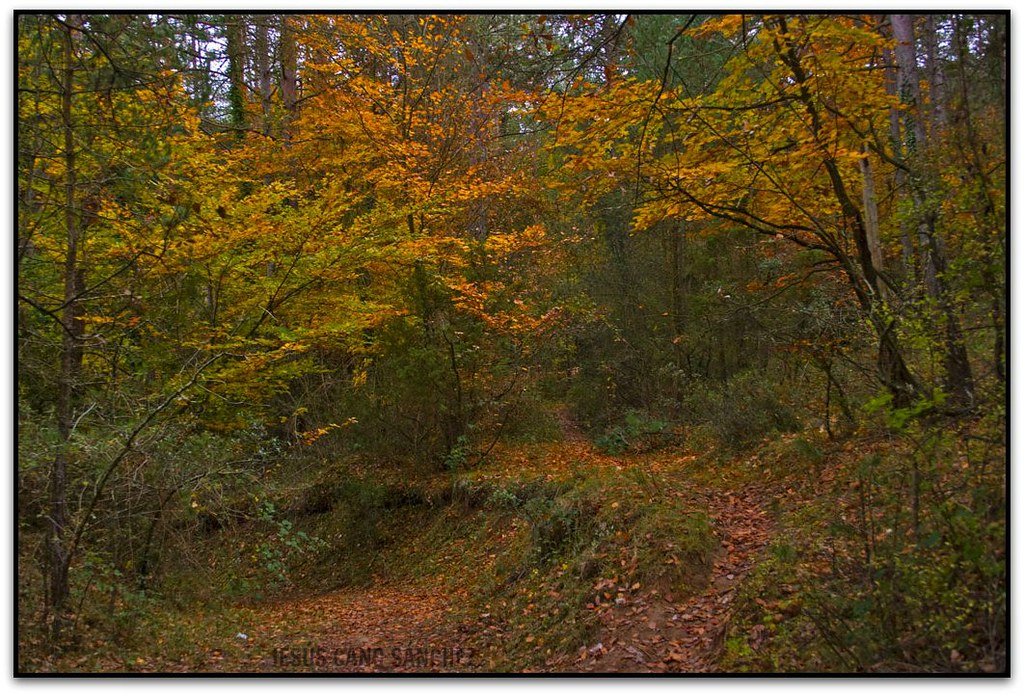 |
| That's the one! |
A similar phenomenon is even observed much further south, where in the heighest parts of Els Ports, above 1000m and right where Catalonia meets Valencia, there is a fageda which clings on in a crevice, el Barranc del Retaule, including the monumental Faig Pare (one day I shall have to pay my respects). That may be the most southerly beechwood forest in Europe.
 |
| El Faig Pare in Els Ports |
As a true old growth forest, the Sauva Negra also hosts species that are not found elsewhere in the vicinity - one notable one is the black woodpecker, the largest species, which requires old growth forests with dead trees for nesting and is otherwise not found until we reach the pre-Pyrenees. I was lucky to glimpse one on my first visit to the Sauva Negra in late December of 2019 - easier in winter, when the exuberant foliage of the place had withered away.
Another feature of this walk is the Castell de Castellcir, also known as the 'Castell de la Popa'; so called because it is perched on a rock which from one angle looks like the stern of a ship. We could walk among these ruins - a medium-sized tree perched within its four walls - and it is lovely to see the way the walls around melt into the surrounding alzinar. At the time of writing (October 2022) I think it is closed and access is not allowed, if the internet is to be believed.
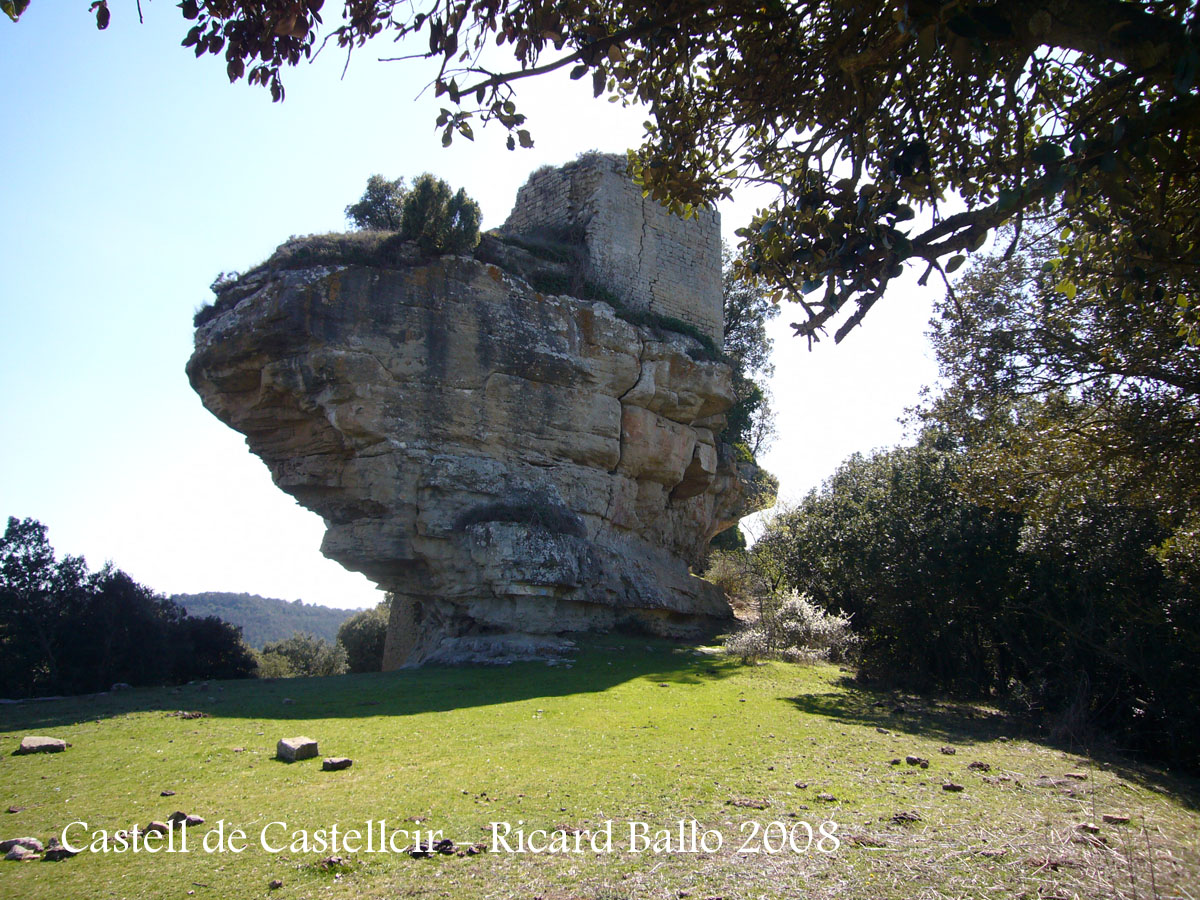 |
| Castell de Castellcir |
HIKERS:
PEZ
K3
Dre
Mix
TRANSPORT:
Rodalies R3 to/from Centelles station.
THE ROUTE:
Our route wased based on route ST195 from senderismeentren.com; climbing up the cliffs from Centelles via the Baga de Riucerda in the shadow of Puigsagordi.
After a well-deserved rest on the cliff-egde we dipped down to visit the Sauva Negra.
We climbed through the forest among flitting woodland birds to the Font de la Sauva Negra, where we stopped for an even more well-deserved lunch.
Afterwards we climbed out back into the more familiar alzinar and to the Castell de Castellcir, for another rest.
At this point our route diverged from ST195; rather than visiting the Castell de Centelles we followed the broad track around to the Morro de Porc, from where a path descends back down to Centelles.
HIGHLIGHTS
A very friendly cat at the start of hike.
A rare glimpse of a wallcreeper on the cliffs under Puigsagordi.
A brief diversion caused by a herd of cows on the path forced us into the bed of the torrent de la Sauva Negra from which the exit was surprisingly hard...
Collecting fir, juniper and rosehips.
Discovery of an unknown aromatic plant within the walls of the castle, which turned out to be calamint (and which looked like Grommit... and it wouldn't do to mention what else it might resemble).


Beset by mad-friendly cat by house at the foot of the cliffs

Baga de Riucerda


At the top of the cliffs


Horny cows forced us off the path into a stream


It wasn't that easy to get out


Comments
Post a Comment